Never Taken IELTS Before? The Complete First-Timer's Guide from Zero to Exam Day (2026)
Everything a beginner needs before booking IELTS: choosing Academic vs. General vs. UKVI, Computer-Delivered vs. Paper IELTS, what happens in all four sections, official Band rounding rules, a 5-step study plan, and test-day musts.
Feeling overwhelmed before your very first IELTS? Take a deep breath: there is no pass or fail, and examiners never deduct points for having a natural non-native accent. Once you understand the test rules and follow the 6 clear steps below, hitting Band 6.5–7.5+ becomes completely predictable.
Last Updated: November 21, 2026Author: Affy Somboontham (ASCEND Lead Strategist · IELTS 8.5 · SAT 1550)Reading Time: ~7 min
4 Skills
Listening • Reading • Writing • Speaking
~2h 45m
Total Exam Time (Band 0.0–9.0 Scale)
~7,500–7,900 ฿
Standard Thailand Academic Fee
2 Years / 1–5 Days
Score Validity / CD-IELTS Results Speed
1. What Is IELTS & Which Test Module Should You Book?
IELTS (International English Language Testing System) is the world’s most widely recognized English proficiency exam, accepted by over 12,500 universities, international degree programs in Thailand, and immigration authorities globally. Every IELTS Test Report Form (TRF) remains valid for two years from the exam date.
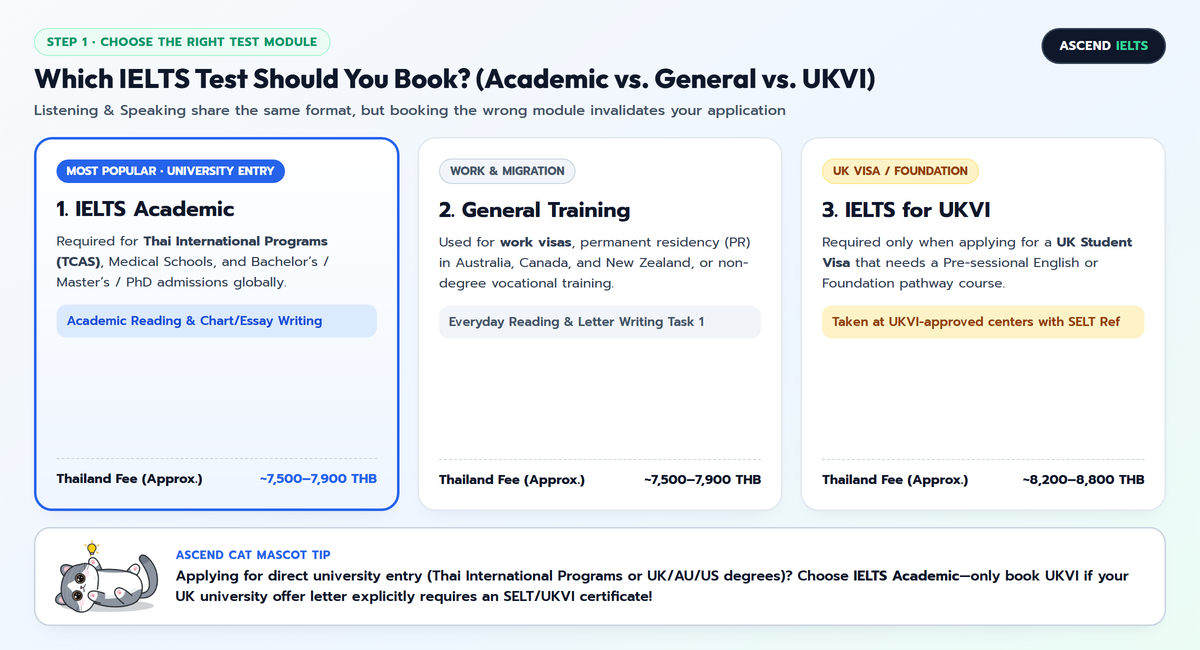
Before paying your registration fee, make sure you select the exact module required by your destination university—booking the wrong version means you may have to pay and sit the exam a second time:
IELTS Test Module
Who Should Take It?
Key Difference
Thailand Fee*
1. IELTS Academic (Recommended for Study)
Applicants to Thai International Programs (TCAS), Medical Schools, and direct Bachelor’s, Master’s, or PhD degrees abroad.
Academic passages & chart/data Task 1 reports
~7,500–7,900 THB
2. General Training
Applicants for work visas, permanent residency (Australia, Canada, New Zealand), or secondary/vocational programs.
Everyday texts & letter-writing Task 1
~7,500–7,900 THB
3. IELTS for UKVI (Academic)
Students applying for a UK Student Visa who must complete a Pre-sessional English or Foundation course before their main degree.
Must be taken at UKVI-approved centers with an SELT number
Visual comparison of all three IELTS modules so you book the right exam on your very first attempt.
2. Computer-Delivered (CD-IELTS) vs. Paper & British Council vs. IDP
First-time candidates often ask whether British Council (BC) or IDP scores more generously. In reality, both organizations jointly own IELTS with Cambridge University Press & Assessment—the test papers, audio recordings, and grading rubrics are 100% identical worldwide. Choose whichever center offers a convenient location and open slot.
What actually changes your test-day comfort is choosing between Computer-Delivered IELTS (CD-IELTS) and Paper-Based IELTS:
Feature
Computer-Delivered (CD-IELTS) • Recommended
Paper-Based IELTS
Results Turnaround
1–5 days (often within 1–2 days)
13 calendar days
Test Date Availability
Available almost every day (morning & afternoon)
Limited dates per month (mostly Saturdays)
Reading Interface
Split-Screen layout (passage left, questions right) with digital highlighters and notes
Must flip paper booklet pages between passage and questions
Writing Experience
Clean keyboard typing, instant editing, and a live Word Counter
Handwritten in pencil; manual word counting required
Listening Audio
Personal headphones with adjustable volume + 2-minute review
Includes 10 extra minutes to transfer answers to sheet
One Skill Retake
Eligible to re-sit 1 module within 60 days at participating centers*
Not available
*Always verify whether your target university accepts IELTS One Skill Retake, as some programs require all four scores from a single sitting.
Inside the Computer-Delivered IELTS interface: persistent split-screen reading, digital highlighter, and live Writing word counter.
COMMON BEGINNER MYTH BUSTED
Choosing Computer-Delivered IELTS does NOT mean speaking to an AI bot! Your Speaking test is still a live 1-on-1 conversation with a certified human examiner—either face-to-face in a private room or via high-definition video call at the test center.
3. Inside All 4 IELTS Sections (What Happens on Exam Day)
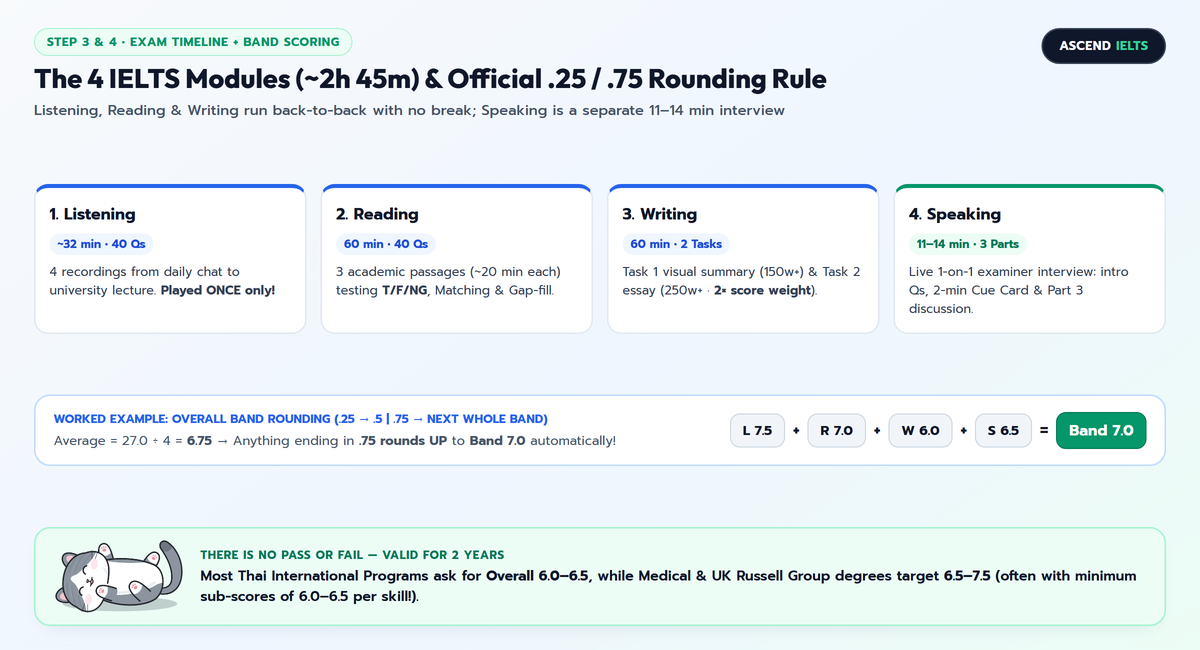
Your Listening, Reading, and Writing modules take roughly 2 hours and 40 minutes back-to-back with no break. The 11–14 minute Speaking interview takes place separately on the same day or within a few days depending on your booking:
MODULE 1 • ~32 MIN • 40 QUESTIONS
🎧 Listening
Four recordings moving from everyday conversations (booking accommodation, campus briefings) to academic discussions and a university lecture. Each recording plays ONCE only. Question types include short-answer completion (watch strict word limits!), multiple choice, and map labeling.
MODULE 2 • 60 MIN • 40 QUESTIONS
📖 Academic Reading
Three full-length academic passages (~700–900 words each) arranged in increasing difficulty. Pace yourself roughly 15 / 20 / 25 minutes per passage—there is no extra transfer time. Key tasks include TRUE / FALSE / NOT GIVEN and Matching Headings.
MODULE 3 • 60 MIN • 2 TASKS
✍️ Academic Writing
Task 1 (20 min recommended · 150+ words): Summarize objective trends from a chart, table, map, or process diagram without giving opinions. Task 2 (40 min recommended · 250+ words): Write a structured academic essay. Remember: Task 2 carries twice the weight of Task 1!
MODULE 4 • 11–14 MIN • 3 PARTS
🎙️ Speaking
Part 1 (4–5 min): Everyday personal questions (study, hometown, hobbies). Part 2 (3–4 min): 1 minute to prepare notes on a Cue Card, followed by a 1–2 minute solo talk. Part 3 (4–5 min): Deeper analytical follow-up discussion connected to Part 2.
4. How IELTS Band Scoring & Official .25 / .75 Rounding Work
Every skill receives a score from Band 0.0 to 9.0 in 0.5 increments. In Listening and Reading, each of the 40 questions is worth 1 mark with zero negative marking for wrong guesses—never leave a blank box! For instance, answering around 30/40 correctly on Academic Reading or Listening typically earns Band 7.0.
Your Overall Band Score averages all four modules and rounds to the nearest 0.5 Band using official thresholds:
A mean ending in .25 rounds UP to .5 (e.g., 6.25 → Band 6.5).
A mean ending in .75 rounds UP to the next whole band (e.g., 6.75 → Band 7.0).
Means ending in .125 or .625 round down to the nearest .0 or .5 band.
Complete 4-module test structure plus how four sub-scores (7.5, 7.0, 6.0, 6.5) average 6.75 and round UP to Overall Band 7.0.
HOW HIGH DO YOU ACTUALLY NEED TO SCORE?
Most Thai international undergraduate programs require Overall Band 6.0–6.5, while Medical programs and top UK/Australian degrees look for 6.5–7.5 (frequently with minimum sub-scores of 6.0 or 6.5 in Writing and Speaking). Test your own target combinations free with our Interactive IELTS Band Score Calculator →
5. How to Start Preparing from Zero: A Proven 5-Step Plan
The #1 mistake beginners make is buying thick practice books and blindly grinding timed tests from day one. Without knowing why answers are right or what examiners look for, your score stays stuck. Follow these five steps in order:
Step 1 — Establish Your Baseline First: Take a short practice quiz or full starter mock to learn your starting Band per skill. Typically, raising your score by 1.0 Band takes 6–8 weeks of consistent practice (90 minutes/day), while closing a 0.5 Band gap takes around 4 weeks.
Step 2 — Learn Task Mechanics & Paraphrasing: IELTS rarely repeats exact words from questions inside the audio or reading text; it tests synonyms (e.g., nocturnal ↔ at night). Master distractor traps in Listening and True/False/Not Given logic before grinding full tests.
Step 3 — Train on a Real Computer Interface Early: If you plan to sit CD-IELTS, practice split-screen Reading, on-screen highlighting, and timed 20/40-minute essay typing so the software feels effortless on exam day.
Step 4 — Get Expert Diagnosis for Writing & Speaking: You can check Listening and Reading keys yourself, but self-studying Writing often plateaus at Band 5.5–6.0 without line-by-line rubric feedback on Task Achievement, Cohesion, and Grammar accuracy.
Step 5 — Hit Your Target in 2 Timed Full Mocks Before Booking: Reserve your official test seat once you consistently reach your required Band in timed practice so you clear IELTS in a single sitting.
Your 5-step study roadmap from day one to exam day—along with the critical ID rule every beginner must follow.
6. Registration & Critical Exam-Day Checklist
Essential Checklist Before You Walk Into the Test Center
Required Identity Document: Bring the exact original, unexpired Passport or National ID used during online registration. (No photocopies or phone screenshots are accepted under any circumstances.)
How Early to Book: Computer-Delivered tests run almost daily and can often be booked 3–7 days ahead; book 2–3 weeks in advance if you prefer Saturday/Sunday mornings.
Arrival Time: Reach the test center 45–60 minutes before your scheduled start for passport check, photograph, fingerprint scan, and locker storage.
Prohibited Items: Leave watches (even analog), smartphones, bags, wallets, and personal pens in the lockers. The center supplies all test equipment; only a clear label-free water bottle and your original ID enter the room.
CRITICAL WARNING FOR FIRST-TIMERS!
Bringing a National ID when you registered online with your Passport—or forgetting your physical ID at home—results in immediate entry refusal with zero refund. Pack your original ID in your bag the night before your exam!
7. Frequently Asked Questions for IELTS Beginners
Can you fail IELTS if it is your first time taking the exam?
No—there is no pass or fail in IELTS. You receive an official Band Score from 0.0 to 9.0 showing your English level across all four skills, and universities simply check whether your Band meets their published admission minimum.
Should first-time test-takers book IELTS Academic, General Training, or IELTS for UKVI?
Choose IELTS Academic if you are applying for international undergraduate degrees (including Thai TCAS international programs), Master’s, PhDs, or medical schools. Choose General Training only for migration/work visas, and UKVI only when a UK university specifies an SELT/UKVI test for a Pre-sessional or Foundation course.
Is there any difficulty difference between British Council, IDP, and Computer vs. Paper IELTS?
No. Both test centers administer identical Cambridge exam papers and follow the exact same global marking standards. Computer-Delivered IELTS (CD-IELTS) is ideal for most candidates thanks to split-screen Reading, a live Writing word counter, frequent test dates, and 1–5 day results.
How much does IELTS cost in Thailand, and how far in advance should I register?
Standard IELTS Academic and General Training fees in Thailand sit around 7,500–7,900 THB (~8,200–8,800 THB for UKVI). Computer sessions can often be booked 3–7 days ahead, though booking 2–3 weeks early is smart for weekend slots.
What must I bring on IELTS test day, and what items are strictly prohibited?
Bring the exact original Passport or National ID used at registration (no phone photos), arrive 45–60 minutes early, and store all watches, phones, wallets, and stationery in the center lockers.
Take Your First Step Free on Real CD-IELTS Software!
See what Computer-Delivered IELTS actually feels like before paying ฿7,500+. Try our zero-signup 5-Question Quick Try in 4 minutes or unlock a full 4-skill starter mock test free for 14 days.